Why Sound Healing Works
You’ll often hear me say, “There’s nothing here to believe in; it’s physics,” and it’s true. Sound healing is rooted in physics. Let me explain.
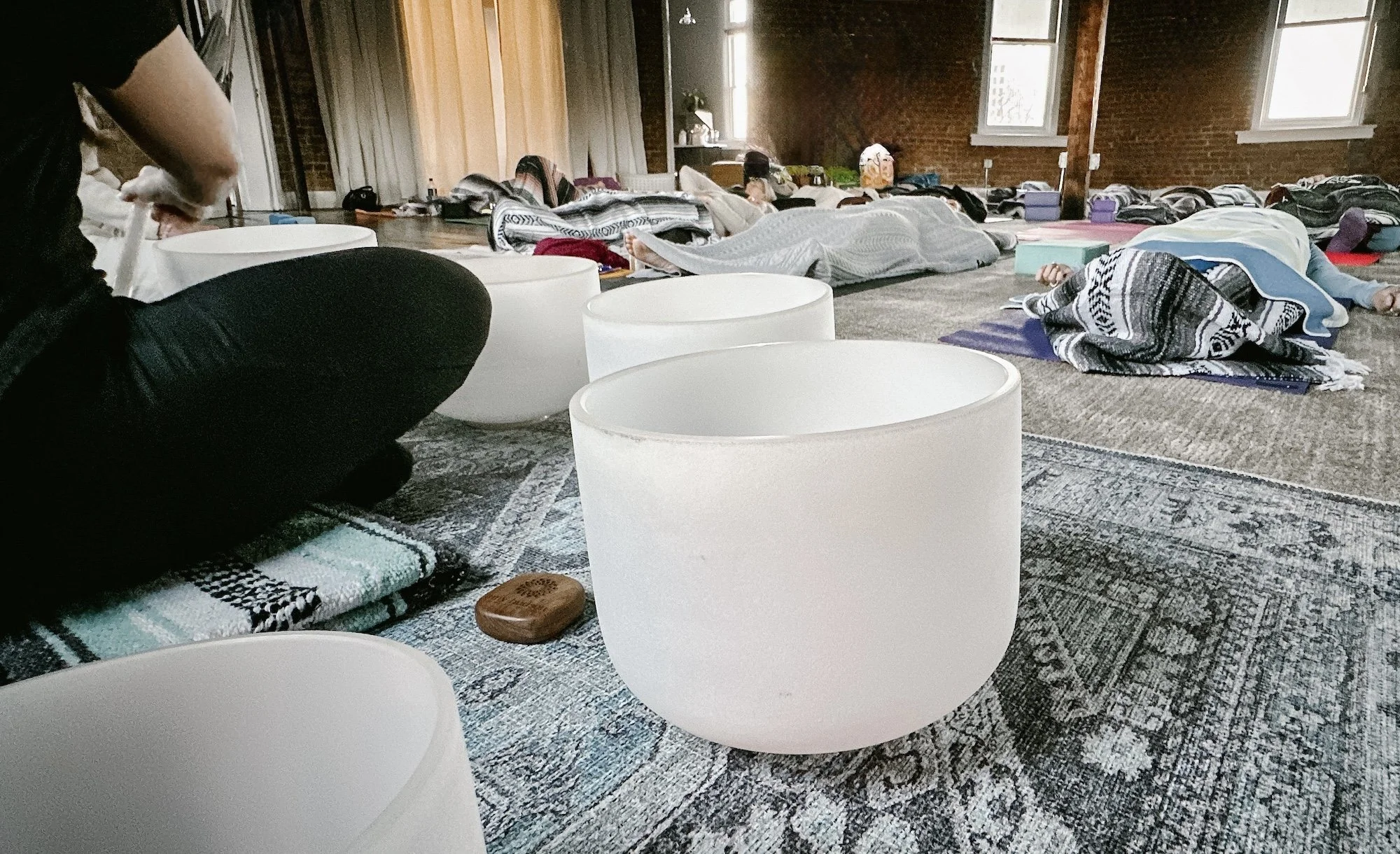
As I play a singing bowl, I create a vibration. That vibration moves the air molecules around the bowl, and then the air molecules vibrate, radiating outward toward you. You may feel this throughout your body, not only your ears. The sound moves through you as it moves through a wall when you can hear what’s happening in the room next door. You may not realize that those sound wave vibrations penetrate your skin and affect the cells and organs inside your body.
So, why does sound healing work? Sound naturally relaxes your body and mind, allowing it to heal itself. Simply put, sound removes the barriers to healing.
Your body, mind, and spirit do not need healing in the way you may think they do. In the absence of toxins, negativity, and limiting beliefs, you function just fine. Like a flowing stream, you do not need to try and be well; you need to remove the things that stop the flow. Without blockages, water flows unrestricted down the stream. Similarly, without blockages, you feel good.
Let’s get more specific. Certain factors make sound an accessible and simple healing modality.
Vibration, Frequency, and Resonance – Everything vibrates all the time. Even something that you believe to be solid matter is still vibrating. Microscopically, scientists can see the space between molecules in a solid object and observe the rate at which it vibrates. Sound waves interacting with matter cause vibration. You can feel this when standing beside a stereo speaker or playing an instrument. This is easy to see with cymatics, where sand or water on a vibrating plate arranges itself into distinct patterns depending on the frequency being played. Change the frequency, and the pattern reorganizes right in front of you. Frequency is the rate at which something vibrates. Some say specific frequencies have different effects on the human body. Here is a more in-depth explanation of the effects of healing frequencies on the body. Resonance is synchronization when the vibrations of one thing match up with the vibrations of another. Your brain interacts with the vibration, is affected by the frequency, and syncs to the therapeutic-grade instrument subconsciously and automatically.
Reduces Stress & Anxiety – Your nervous system has two main modes: fight-or-flight and rest-and-digest. Most of us spend the majority of our day in the first one, even when nothing is actually wrong. Sound has a direct effect on this. Slow, sustained tones signal to your nervous system that it's safe to shift into rest-and-digest mode. Your heart rate slows, your breathing deepens, and your body begins producing less cortisol, the hormone tied to stress. This is part of why people often describe a sound bath as the first time all week they've deeply relaxed.
Re-train Your Brain – Your brain moves through different wave states depending on what you're doing. During a busy day, you're mostly in beta, an alert, thinking state. Meditation and deep relaxation are associated with slower states like alpha and theta. Sound can help guide your brain into these slower states without requiring you to meditate in the traditional sense. This is sometimes called brainwave entrainment: your brain naturally begins to sync its rhythm to a steady external rhythm, like a singing bowl. Over time and with repeated practice, this can make it easier to access these calmer states even outside of a session.
Energy Flow – Long before physics had language for vibration and frequency, cultures around the world understood the body as something that needs to move and flow, not just function. When you're stressed, held tension, or carrying something you haven't processed, that flow gets restricted. Sound moves through the body the same way it moves through the air, and many people describe feeling something shift or loosen in a specific area during a session, even without knowing why. Whether you think of this as energy, tension, or simply the nervous system finally getting a break, the result tends to be the same: things move again.
Biochemical Effects – Beyond the nervous system, sound appears to influence the body at a chemical level. Some studies point to increases in oxytocin (the hormone associated with bonding and connection) and endorphins (your body's natural painkillers) during sound-based practices. Others have looked at melatonin, the hormone that regulates sleep, which may explain why so many people fall asleep during a sound bath despite lying on a hard floor in a room full of strangers.
While these explanations offer insights into why sound healing works, it's essential to note that more scientific research is needed to fully understand its mechanisms and efficacy. Additionally, individual experiences with sound healing vary, and what works for one person may not have the same effect on another.
The best way to understand any of this is to actually feel it. If you feel called, join us for a sound bath and experience the physics for yourself.